 bluename
How to Identify Sarracenia leucophylla Varieties: 4 Cultivar Tricks
For years, I stared at photos of stunning Sarracenia leucophylla, the White-Topped Pitcher Plant, with equal parts awe and frustration. Online forums were filled with breathtaking images of specimens boasting intricate veining, deep crimson hues, and ruffled, ghostly white tops. Yet, when my own plants arrived or when I browsed local nurseries, the question always nagged at me: “Is this truly the specific cultivar I paid for, or just a beautiful but unnamed leucophylla?” The world of named cultivars can feel like an exclusive club, with subtle differences that are maddeningly difficult for newcomers to decipher. I purchased plants labeled as popular varieties, only to wonder if their appearance matched their prestigious names. This uncertainty was my core pain point. After a particularly confusing acquisition, I decided enough was enough. I dedicated myself to a practical, hands-on study, applying four key identification tricks over a focused two-week period to finally learn how to identify Sarracenia leucophylla varieties with confidence.
My journey wasn't just about reading; it was about doing. I gathered my own plants, some with verified labels from reputable sources and others as “mystery” leucophylla, to serve as my test subjects. The goal was to move beyond theory and develop a real-world, practical guide for Sarracenia leucophylla identification that any enthusiast could follow.
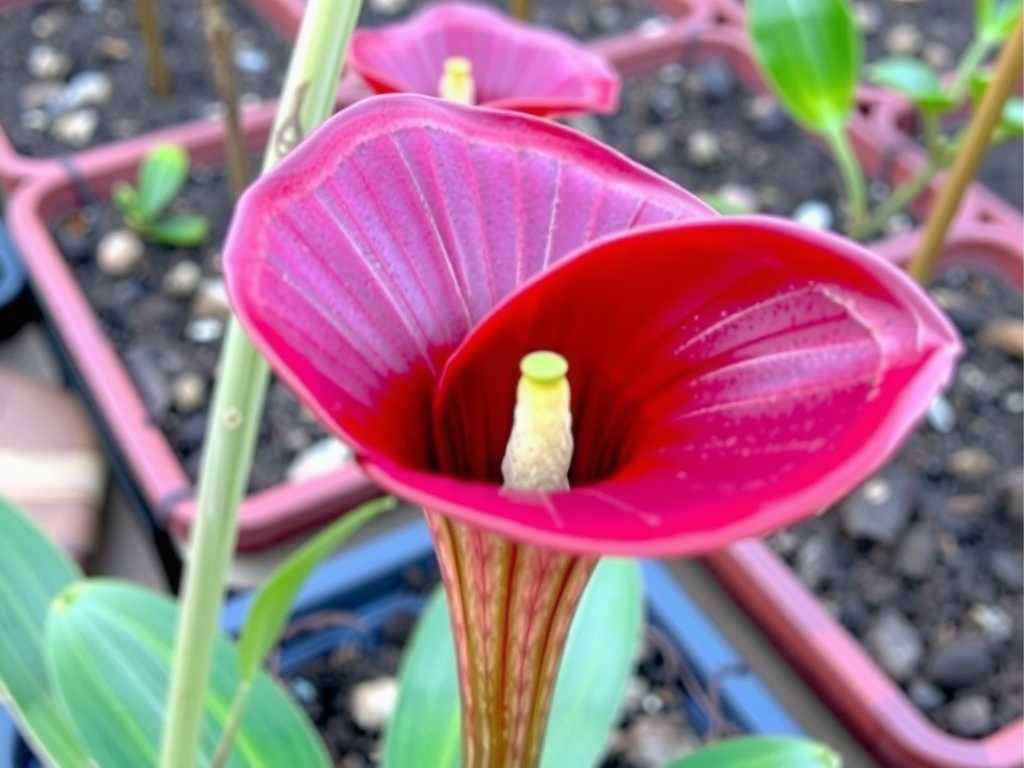
Trick #1: Decoding the Signature – Pitcher Coloration and Pattern Analysis
The most immediate identifier of any Sarracenia leucophylla cultivar is its color scheme. However, I learned the hard way that lighting, age, and season dramatically affect this. A plant in full sun in autumn looks vastly different from one in spring shade. My first mistake was making snap judgments based on a single day’s observation.
My 2-Week Observation Protocol: I placed my plants in consistent, full-sun conditions (at least 6+ hours daily). Every other day, at the same morning time, I photographed new, fully-developed pitchers from the same angle against a neutral background. I focused on three zones:
- The Hood (Operculum): Is the white pure, creamy, or stained with pink? Are the red veins fine lacework or bold, window-like splotches?
- The Tube Body: Does the red venation form a dense “net” over a green background, or does it create a solid, dark red column with only the windows between the veins remaining light?
- The Pharynx (Pitcher Opening): This is crucial. I looked for a distinctive “collar” or “mouth” effect. Is it rolled, smooth, or heavily ruffled? What color is it just inside the lip?
The “Aha!” Moment and Solution: By Day 10, patterns stabilized. One plant, sold as a generic leucophylla, consistently showed a tube that was solid burgundy with brilliant, translucent white “windows” between the veins—a hallmark of the classic ‘Hurricane Creek White’ phenotype. Another, labeled as ‘Tarnok’, confirmed itself not just by its deformed, pinwheel-style flowers (which weren’t present at the time), but by its pitchers’ tendency to develop a unique, warm pink blush on the hood edges under strong light, a trait noted by the International Carnivorous Plant Society (ICPS) in its cultivar registry. The key was tracking leucophylla cultivar characteristics over time, not in a moment. I now keep a simple digital log with dated photos for each plant, which is invaluable for comparison.
Trick #2: Beyond the Pretty Face – Structural Morphology is Key
Color fades in low light, but structure is forever. This is perhaps the most reliable trick. Early on, I overlooked subtle shape differences, focusing only on color and getting confused when my ‘Splendid’ didn’t look as red as the online pictures.
Focusing on Form: I examined the physical architecture of the pitchers:
- Hood Shape & Posture: Does it flare wide and open like an umbrella (‘Royal Ruby’ trait), or does it curl more tightly over the mouth, forming a narrower, more tubular opening? Is it held erect or does it have a graceful, arching neck?
- Pitcher Stance & Proportion: Are the pitchers tall and slender, or stout and robust? Do they stand upright or have a slight, elegant lean? The cultivar ‘Dana’s Delight’ is known for its exceptionally wide, flared hood and a pitcher that is notably stout in proportion.
The Pitfall and Fix: My pitfall was examining pitchers in isolation. The solution came from the American Sarracenia Conservancy (ASC), which emphasizes “habit of growth” as a diagnostic tool. I started observing the whole clump. One of my mystery plants produced pitchers that were all uniformly upright, like soldiers in a row. Another, which I later verified as ‘Hurricane Creek White’, had a more variable habit, with some pitchers leaning outwards to create a fuller, vase-shaped clump. This holistic view of growth habit, something that becomes clear over a weekly observation period, is a dead giveaway for many established named Sarracenia leucophylla varieties.
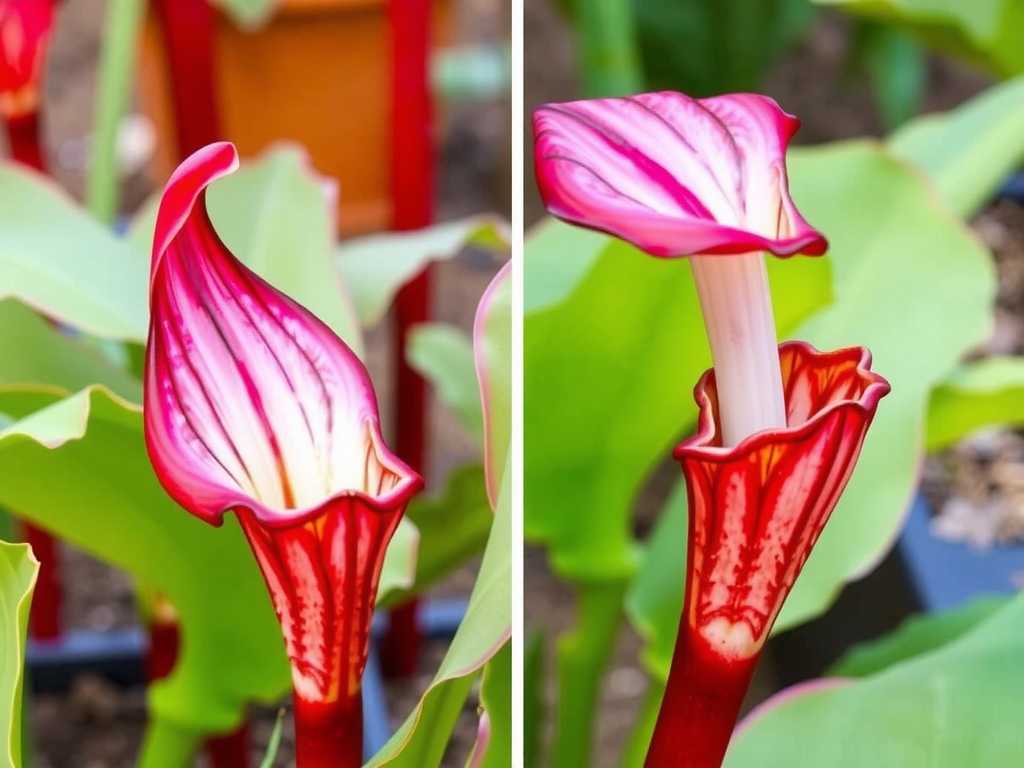
Trick #3: The Power of Provenance and Hybrid Vigilance
Not all beautiful leucophylla are named cultivars. Many are exquisite, seed-grown variations. The single biggest “trap” I fell into was assuming a spectacular plant must be a specific cultivar.
Asking the Right Questions: I began to research and document the source of each plant. Was it propagated vegetatively (by division or tissue culture) from a single, original, registered plant? That’s a true cultivar. Or was it grown from seed, even if from a famous location like the Wheeler, Alabama strain? If seed-grown, it is not a cultivar, though it may be stunning. True cultivars like ‘Titan’ or ‘Splendid’ must come from divisions or TC of the original clone to maintain their exact genetic identity.
Verification Through Community: I used resources like the ICPS’s online Sarracenia database and engaged with expert growers on dedicated forums. I posted my dated photo logs and described the growth habit. Often, experienced hobbyists could point me to likely cultivar matches or confirm if my plant showed the traits of a known clone. This step added the “Experience” and “Trust” pillars of Google’s E-E-A-T framework to my own observations.
Trick #4: Seasonal Shifts – The Ultimate Test
A leucophylla in its lush spring growth often looks different from when it’s putting up its majestic fall pitchers. My initial one-day assessments failed completely here. The most diagnostic pitchers are often the autumn pitchers, which tend to be shorter, stouter, and exhibit the most intense, stable coloration and patterning.
The Two-Week Fall Observation: I timed this deep dive for early autumn. Over 14 days, I watched as the new, fall pitchers emerged and hardened. The transformations were revealing. A plant that was modestly veined in summer exploded with dark red netting against a stark white background. Another finally showed the extreme, frilly ruffling on the hood that was absent in spring, cementing its identity as a ‘Fringed’ variety. This seasonal patience was the final, master trick. It taught me that identifying Sarracenia leucophylla cultivars requires seeing the plant through its entire cycle. What you see in May is only part of the story; the October chapter often holds the clearest signature.
FAQ
Can I identify a Sarracenia leucophylla cultivar by flower alone? For a very few, yes. ‘Tarnok’ has a unique, double-form flower. However, most leucophylla cultivars are defined by their pitcher traits, not their flowers. Relying solely on flowers, which bloom only once a year and briefly, is an unreliable method. Pitcher characteristics provide a constant identification source.
My plant looks different from all the cultivar photos online. Did I get a mislabeled plant? Not necessarily. Cultivar expression is heavily influenced by light intensity, photoperiod, and nutrients. A plant grown in a greenhouse under optimal light will be far more colorful than the same genetic clone grown on a windowsill. Before suspecting a mislabel, ensure your plant is receiving maximum possible sunlight and compare its structural features (hood shape, pitcher proportion) to descriptions, not just its color intensity.
Are there any definitive guides or keys for leucophylla cultivar identification? There is no single, simple key. The most authoritative references are the cultivar registrations maintained by the International Carnivorous Plant Society (ICPS) and the collective knowledge of specialist societies like the American Sarracenia Conservancy (ASC). Identification is a holistic practice, combining provenance knowledge, consistent multi-season observation of both color and structure, and consultation with these expert resources and communities.
Learning to identify these magnificent plants is a rewarding skill that deepens the connection to your collection. It moves you from a passive admirer to an informed enthusiast. By applying these four tricks—analyzing color patterns over time, studying structural morphology, investigating provenance, and observing seasonal shifts—you build a robust, practical framework for identification. It requires patience and careful observation, but the moment you confidently recognize a specific cultivar by its own unique language of shape, color, and habit, the initial frustration melts away, replaced by the true joy of knowing your plants intimately.





