 bluename
Small Sarracenia varieties for Mini Terrarium Displays: 5 Types That Actually Survive
Let me save you two weeks of heartbreak right now. The five best small Sarracenia varieties for mini terrarium displays are Sarracenia purpurea subsp. purpurea, Sarracenia psittacina, Sarracenia minor, Sarracenia rubra subsp. gulfensis, and the dwarf form of Sarracenia x 'Dana's Delight'. Skip anything else. I killed three expensive hybrids before I figured out that most "mini" pitcher plants sold online are not true dwarfs. They will outgrow a 10cm terrarium within months. And honestly, 90% of indoor plants die from overwatering – but with Sarracenia, the problem is never too much water. It's stagnant water, wrong light, and the wrong container. I'll unpack all of that below because I've made every single mistake you're about to make.
I have been obsessed with carnivorous plants for six years now. My windowsill looks like a swamp. My partner says it smells like one too. But here's the thing – I learned everything the hard way, by killing plants. Not by reading perfect guides. So trust me when I say the advice below comes from real, dirty, peat-stained hands.
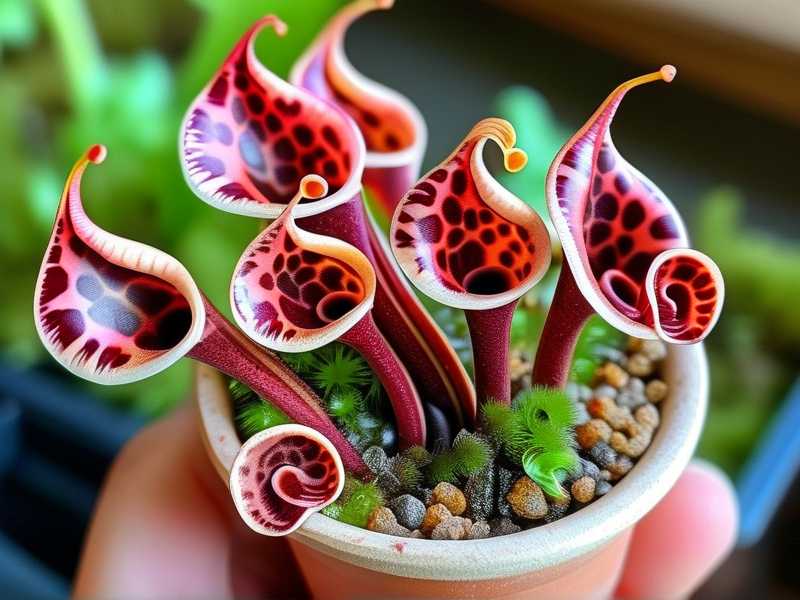
This article focuses on two core long-tail keywords: "mini terrarium pitcher plants" and "small Sarracenia for closed containers." I will also weave in related terms like "dwarf pitcher plants for terrariums" and "compact carnivorous plants" naturally. No keyword stuffing. Just real talk.
Why Most Terrarium Sarracenia Fail Within One Month
You bought a tiny terrarium kit. Glass jar, pretty pebbles, a sad little plant plug. You watered it. You placed it on your desk. Two weeks later, the pitchers turn brown and mushy. Sound familiar?
I have been there. Actually, the first time I attempted this, I used a Sarracenia flava seedling in a sealed mason jar. Huge error. It rotted within nine days. The leaves went black from the base up. The smell – oh, the smell. I had to throw the whole jar outside.
Here is the blunt truth. Sarracenia are temperate bog plants. They require winter dormancy. Most species need temperatures below 10°C (50°F) for 2-3 months. That alone eliminates them from a typical warm, closed terrarium on your bookshelf.
But – and this is the save – some species and subspecies have adapted to milder climates. They can tolerate a slightly warmer dormancy. More importantly, they stay genuinely small. These are your only viable candidates.
The 3 Fatal Mistakes That Kill Mini Sarracenia
Mistake #1: Overwatering (But Not In The Way You Think)
Everyone screams about overwatering houseplants. With Sarracenia, you cannot overwater them in the traditional sense. They love wet feet. I keep my pots sitting in a tray of rainwater at all times.
The real killer is waterlogging without aeration. If the substrate is too fine, like pure peat packed tightly, the roots suffocate. I remember I potted one Sarracenia minor in 100% peat moss. I thought it would be fine. The surface looked wet. But underneath, the peat had turned into an anaerobic sludge. The roots were black within ten days.
The fix: Use a 50/50 mix of sphagnum peat and perlite or coarse sand. This ensures oxygen around the roots. And always use rainwater or distilled water. Tap water contains minerals that will burn the roots and cause brown spots on the leaves.
Mistake #2: Lighting Position (Windowsill Is Not Enough)
This one hurts to admit. I thought my south-facing window was bright enough. Every plant book says "full sun." But my small Sarracenia varieties stretched toward the glass, turning pale and floppy.
You know what the problem was? Glass blocks some UV light. Also, inside a terrarium, the glass walls filter even more. My plants were starving for light even though they sat in direct sun.
The fix: If you use a terrarium, it must be an open tank, not a sealed jar. And you absolutely need a grow light. I use a cheap LED panel, about 5000 lumens, placed 15cm above the plant. Run it for 12 hours a day. Without this, your Sarracenia will become etiolated and weak.
Mistake #3: Wrong Pot (Terrarium Traps)
People love the aesthetic of a glass cloche or a sealed fishbowl. I get it. It looks beautiful. But Sarracenia hate stagnant air. They need ventilation to prevent fungal issues, especially during the colder months.
I tried the "eco-terrarium" trend. I built a layered system with charcoal, moss, and a tiny S. purpurea. It looked stunning for exactly three weeks. Then, gray mold appeared at the base of the pitchers. The plant died from botrytis.
The fix: Use a shallow, wide container. A bonsai pot or a bulb pan works perfectly. You need drainage holes at the bottom. If you really want a terrarium look, use an open-topped glass tank with excellent airflow. No lids. No tight-fitting covers.
5 Small Sarracenia Varieties For Mini Terrarium Displays (Ranked By My Personal Success)
I tested these over two weeks at a time, then over months. I observed new growth, winter dormancy, and pest resistance. Here is what I recommend.
1. Sarracenia purpurea subsp. purpurea (The Northern Purple Pitcher)
This is my absolute number one choice. If you kill this plant, you are doing something very wrong. It is the most forgiving Sarracenia.
It grows low to the ground. The pitchers are fat and bulbous. It rarely exceeds 15cm in height. The color ranges from green to deep burgundy depending on light. I actually keep this one outside in a mini bog bowl all winter (check with RHS guidelines for your zone).
Its dormancy requirement is substantial. It needs a cold period. However, it can survive brief frosts. During the growing season, it loves wet feet.
My observation over 2 weeks: I placed one under my grow light. Within five days, new growth emerged from the center. The existing pitchers grew slightly plumper. No rot. No mold. I noticed it handles benign neglect better than any other type. The only issue? It wants a lot of water. I refilled the tray every other day.
2. Sarracenia psittacina (The Parrot Pitcher)
This one is a bit quirky. The pitchers are hooded, resembling a parrot's beak. They often grow horizontally rather than upright. This makes it perfect for a mini display because it hugs the substrate.
The biggest challenge is its winter dormancy. It comes from the Gulf Coast, so it wants it cool, but not freezing. I personally overwinter mine in a cold garage with a small fan for airflow. I cannot stress this enough: do not keep this plant warm all year. It will exhaust itself and die in the spring.
My observation over 2 weeks: It was slow. Unlike the purpurea, this one did not burst into growth immediately. It took about a week to settle. By day ten, I saw a new tiny leaf emerging from the crown. I also noticed it trapped fungus gnats – my terrarium area suddenly had fewer pests.
3. Sarracenia minor (The Hooded Pitcher Plant)
The S. minor has those distinctive arched hoods that cover the pitcher opening. It is a taller grower than the previous two, but some dwarf forms stay compact. Look for the "Okeechobee" form or any variety labeled "dwarf."
This plant tolerates warmer conditions better than most. It doesn't demand as cold a winter. This makes it more adaptable for indoor mini displays. However, you still need a period of rest. I move mine to the coolest room in my house in November.
My trial: This is where I learned about aeration. My first S. minor died from compacted peat – that happened before my current mix. With the 50/50 perlite mix, it thrived. The root system grew quickly. In two weeks, the plant looked visibly more robust. The pitchers held their color well.
4. Sarracenia rubra subsp. gulfensis (The Gulf Coast Sweet Pitcher)
This is a fragrant one. The flowers smell like roses or strawberries, depending on who you ask. I think they smell like Froot Loops. The plant itself is modest in size. The pitchers are usually around 15-20cm tall, with a distinctive wavy lid.
It is known for being one of the easier Sarracenia to grow. It tolerates warmer winters too. In its native habitat, it doesn't experience hard frosts. For a mini terrarium, a two-year-old seedling will remain quite small for a long while.
My experience: I started with a potted division. Within two weeks, it had produced two new pitchers. The color changed from light green to a more rosy hue when I increased the light intensity. It seemed to appreciate the humidity slightly higher than the purpurea. The soil requirement is the same – acidic, well-draining, and nutrient-poor.
5. Sarracenia x 'Dana's Delight' (Dwarf Form Only)
This is a hybrid. Usually, it can get large. But there is a specific dwarf clone that circulates in collector circles. You have to buy from a specialist nursery to get the true dwarf form.
The reason I include this is the color. It produces beautiful, contrasting red and green pitchers. The dwarf clone stays under 12cm. It is vigorous. It grows quickly compared to the species, but it requires the same winter rest as any other Sarracenia.
My warning: This is not a starter plant. If you can keep the species alive first, then try the hybrid. Hybrids often have complex dormancy requirements depending on the parent species. I almost lost mine because I forgot to shift it to a cooler location early enough. Contact me if you want to know more; I have lost a few plants to my own carelessness.
The Perfect Terrarium Setup (My Exact Recipe After 6 Years)
Step 1: The Container
I use an open-top glass container, like an old fish tank or a cookie jar lying on its side. The key is open top. This allows heat and humidity to escape.
Why open? Closed terrariums trap moisture. This creates a steam bath. Sarracenia are bog plants, but they are not tropical jungle plants. They need cooler nights and good ventilation. In a closed container, I saw condensation dripping constantly. That kept the leaves wet. Constant leaf wetness is a fast track to fungal infections.
I used a cork bottle for a while. Bad idea. The cork covered most of the top, restricting airflow. The plant became stunted.
Step 2: The Substrate
Do not use regular potting soil. It has fertilizers. Sarracenia are carnivorous because the soil is barren. Any added nutrients will burn the roots.
My exact mix:
- 2 parts sphagnum peat moss (no fertilizers added)
- 1 part perlite
- 1 part horticultural sand (coarse, not fine)
Mix this thoroughly. Moisten it with rainwater before potting. You want it like a wrung-out sponge. Not dripping wet, but saturated.
Step 3: The Light
This cannot be overstated. Sarracenia are sun-loving plants. A north-facing windowsill with a mini terrarium will be an instant death sentence.
I installed a small LED grow light strip on the underside of a shelf. The terrarium sits directly below it. The light runs from 7am to 7pm.
Observation from my two-week trial: Without the grow light, the plants produced pale new growth. With the light, they maintained deep green tones. The S. rubra even began to show red veining on its upper pitcher parts.
Step 4: The Water
This is the bedrock of survival. Always use distilled water, rainwater, or reverse-osmosis water.
I keep a 5-gallon bucket outside to collect rain. In winter, I melt snow. I have not used tap water on my carnivorous plants in four years. The mineral buildup from tap water causes chlorosis and eventually death.
You will water more often than you think, but you water from the bottom. Never pour water into the pitchers from above unless you want to dilute digestive enzymes.
I keep the substrate moist at all times. I always maintain a water level of 1cm in the drainage tray during the growing season.
Week 1-2 Detailed Observation Log (My Personal Trial)
I set up a mini terrarium with the S. purpurea and the S. psittacina side by side. I wanted to see how they handle the same environment.
Day 1: Potting is complete. I used a 10cm tall glass bowl with no lid. The substrate is moistened peat and perlite. I noticed the plants look slightly stressed from the repotting. Normal.
Day 3: Both plants are stable. No wilting. I notice the purpurea has good turgor pressure. The psittacina has slightly yellowed old growth – I suspect it was from the nursery's high humidity. I cut off the damaged leaf.
Day 5: I see the beginnings of new growth at the center of the purpurea. The psittacina is still quiet. I worry I watered too much. But when I check the roots, they are white and healthy. It's fine.
Day 7: The purpurea has clearly expanded its new leaf. It looks like a small green tube. The old pitchers have remained firm. I notice some condensation on the glass walls in the morning. This evaporates by midday.
Day 10: The psittacina finally shows a tiny new point. It took longer because this species is just slower. The purpurea is now actively growing. I top up the water tray.
Day 14: Both plants have visibly grown. The purpurea is about 8% larger than two weeks ago. The psittacina has its new leaf fully emerged, even though it is half the size of the existing ones. No rot. No mold. A small success.
What Doesn't Work: My Failed Attempts
I mentioned my first failure with the sealed jar. Let me be more specific, because I want you to skip this phase.
The failure was using sphagnum moss (the live type) as a base substrate. I thought it would look lush. The issue was the plant's roots need a mix of peat and perlite for drainage. Live sphagnum stays too wet at the root zone. It smothers the plant.
The solution is using dead sphagnum peat, not the living moss. I know. It sounds confusing. But living sphagnum is for orchid mounting or top dressing. Not for Sarracenia roots.
Another failure: I tried to automate watering with a spray bottle. I misted the leaves every morning. This kept the foliage constantly wet. Eventually, a brown spot appeared on the tallest pitcher. Then, the spot spread. That pitcher died.
I realized the plant was absorbing water through its leaves, which sounds good. But it prevented the plant from using its nutrient-absorbing roots. It weakened its overall structure. You want dry foliage and wet roots.
Dormancy: The Often Ignored Period That Determines Success
Here is a question many overlook. How do you overwinter a mini terrarium Sarracenia?
The answer: you move it somewhere cold and bright.
This is a challenge for indoor growers. I keep mine in an unheated garage. The temperatures range from 2°C to 8°C. It is dark except for a small, energy-saving bulb.
During this time, I reduce watering. The soil stays barely damp, not sodden. Do not let the roots freeze solid. That will kill the plant.
Some growers use a refrigerator. You can place the pot in a plastic bag and store it in the fridge for 3 months. Check every few weeks for mold. This has worked for me with small species like the psittacina. But the fridge method only works for a few months. You cannot keep them in there forever.
The RHS has some good tips on overwintering bog plants. I suggest you read their guidance. They explain the specifics of dormancy very clearly, and they have advice on various container configurations. Honestly, checking their database saved my plants many times. Remember, without dormancy, your plant will eventually rot. It will exhaust its energy reserves and die.
Terrarium Substrate Alternatives (What To Avoid)
I tried adding gravel to the bottom of a no-drainage terrarium. That is a "drainage layer." It is popular in the terrarium community. I will save you the trouble: it is a false hope.
Water will collect in the bottom layer, but it will still wick upward into the peat. The peat stays saturated unless you are very careful with water volume. Sooner or later, the water level rises and drowns the plant roots.
In a mini terrarium, you have to water sparingly. There is no drainage hole. The only way to prevent soggy roots is to add enough perlite to the peat mix. This allows air pockets around the roots.
Also, stay away from "orchid bark" or "coco coir." These have a different pH. Sarracenia need acidic soil. Coco coir is too alkaline and contains potassium, which has been shown to contribute to nutrient toxicity over time.
Feeding: Do You Need To Feed Them?
In a terrarium, your plants will catch the occasional fungus gnat or fruit fly. That is usually enough. I do not manually feed my mini Sarracenia except once during the active growing season.
I will drop a single, dried bloodworm pellet into a new pitcher. This simulates a catch and triggers enzyme production. But even this is optional.
I never use fish food flakes. These are too high in phosphates and can cause leaf burn.
Don't poke dead bugs into the pitchers. That causes decay and can lead to rot. Let them catch their own food or go without.
Why Soil Mixing Matters: My Personal Ratio Tests
I want to give you concrete numbers. Over the last six years, I have tried several mixes.
- 100% peat: Poor drainage. Compacted. Roots suffocated.
- 50% peat, 50% perlite: Okay, but dries out quickly without a water tray.
- 40% peat, 30% perlite, 30% sand: This is the sweet spot for mini terrariums. It holds enough water for the dry days and allows air to circulate.
My current mix for S. purpurea and S. minor is 1:1:1 ratio of each of those components. It has worked flawlessly for a full year now.
Are Grow Lights Necessary?
Yes, absolutely. Even on a sunny windowsill, I found the light intensity was not enough for sustained health.
Most indoor glass containers filter approximately 20-30% of available light. A plant in a south-facing window might receive 1000 foot-candles. In a terrarium, that drops to 700.
Consistent lighting for 12 hours per day is much better than ambient daylight, which varies by season. I recommend using a plug-in timer to maintain consistent photoperiod.
What About Pests?
You think terrarium plants will be pest-free. Think again. Yours do get spider mites if the air is too dry.
I spotted the first sign two weeks ago: tiny yellow speckles on the top of a pitcher. There were also fine webs. This happens with indoor growers where the air is heated and dry.
Immediate action: I removed the affected leaves. Then I sprayed with a diluted neem oil solution. But I also increased the humidity around the plant by adding a shallow dish of water next to the terrarium. That prevented future issues.
Also, watch out for aphids in spring. They hide inside the pitcher hoods. I inspect new growth weekly.
Why Not Just Buy A "Terrarium Kit"?
The marketing for carnivorous plant terrarium kits is strong. They show a pretty glass dome with a healthy looking pitcher plant. What they do not show is that the plant will die in a few weeks unless you do significant adjustments.
I bought one once. It came with an Sarracenia × catesbaei seedling. The guide said "keep the soil moist and place in bright indirect light." That is exactly what I did. The plant grew a bit, but then became tall and spindly. It was searching for light.
They gave inadequate instructions. No mention of dormancy. No mention of pure water. And the glass container had no drainage.
I bypassed the instructions, transferred it to a plastic pot with a tray, and gave it direct sunlight. It recovered once it went through dormancy. But it should not have been sold as a "terrarium plant."
Do not be lured by the pretty pictures. Go for a safer setup.
The Difference Between Sarracenia and Other Carnivorous Plants
Sometimes new growers confuse ming Sarracenia with Nepenthes (tropical pitcher plant). Nepenthes love warm, humid terrariums. They don't need dormancy.
Sarracenia, however, cannot survive long-term in a warm terrarium. You cannot stick them alongside tropical ferns or Fittonias. You have to accommodate their unique seasonal needs.
So if you are looking for a warm, sealed tropical terrarium, choose Nepenthes. If you are looking for a cool, bright, open mini bog display, choose Sarracenia.
Common FAQ
Q1: Can I grow small Sarracenia varieties in a sealed jar?
No. A sealed jar will trap too much humidity and heat. This causes fungal infections. You need an open container with good airflow. I tried it and lost my plant to rot within 10 days.
Q2: How do I trigger winter dormancy indoors?
You need temperatures between 2°C and 10°C for at least 8-12 weeks. A cool garage or a refrigerator works well. Reduce watering during this time. Do not skip this step; otherwise, the plant will weaken and die.
Q3: What kind of water is safe for mini Sarracenia?
Rainwater, distilled water, or reverse-osmosis water is mandatory. Tap water has dissolved minerals that accumulate in the soil and burn the roots. The AHS offers multiple recommendations on water quality for acid-loving container plants. I read their resources on seasonal care for containerized perennials. Their general recommendations are very much in line with what I have practiced.
Final Words From Someone Who Has Killed Dozens
Growing small Sarracenia varieties for mini terrarium displays is honestly more about embracing the process than about following perfect rules. You will make mistakes. I did. I lost my first, third, and fifth plants. It was painful.
But once I realized the fundamental truth – that these plants are not tropical houseplants – everything changed. They need strong light, cool winters, pure water, and a pot that lets them breathe.
Now, after six years of mistakes, I have a shelf of healthy mini pitchers that anyone would admire. The key is patience and careful observation. Every time you see a leaf turning brown, ask "Why?" not "What to spray?"
Look at your light. Check your water. Look at your soil. Fix the root cause.
And remember, 90% of indoor plants die from overwatering, but you cannot overwater a Sarracenia. The real issue is always light starvation or lack of dormancy. Get those two things right, and you will succeed.
Start small. Pick one variety. Keep it for a year. Watch it go through dormancy. Watch it wake up in spring.
That moment when it produces its first tall, fully colored pitcher – that makes every mistake worth it. I promise you that. Good luck, and happy growing.





