 bluename
How to Choose Sarracenia for Experts: 5 Rare Variety Tricks
Let’s be honest. If you’re reading this, you’ve likely mastered the basics of keeping a Sarracenia alive. You know about full sun, mineral-free water, and the dormancy dance. Your common pitchers thrive. But now, you’re staring at a vendor list of rare cultivars and species, your cursor hovering over “Add to Cart,” paralyzed by a new, more complex set of questions. Which of these stunning rarities will actually thrive in your conditions, not just survive? How do you move beyond the catalog photo and choose a plant that matches an expert’s ambition? I’ve been there, wasting money on a “must-have” that languished while a less-hyped gem became the crown jewel of my collection.
After years of focused cultivation and a particularly revealing two-week experiment I’ll detail below, I’ve distilled the process into five non-obvious tricks. This isn’t about general care; it’s the advanced scouting report for selecting the rare Sarracenia that will elevate your collection from impressive to exceptional.
Look Beyond the Lid: The “Throat Map” Assessment
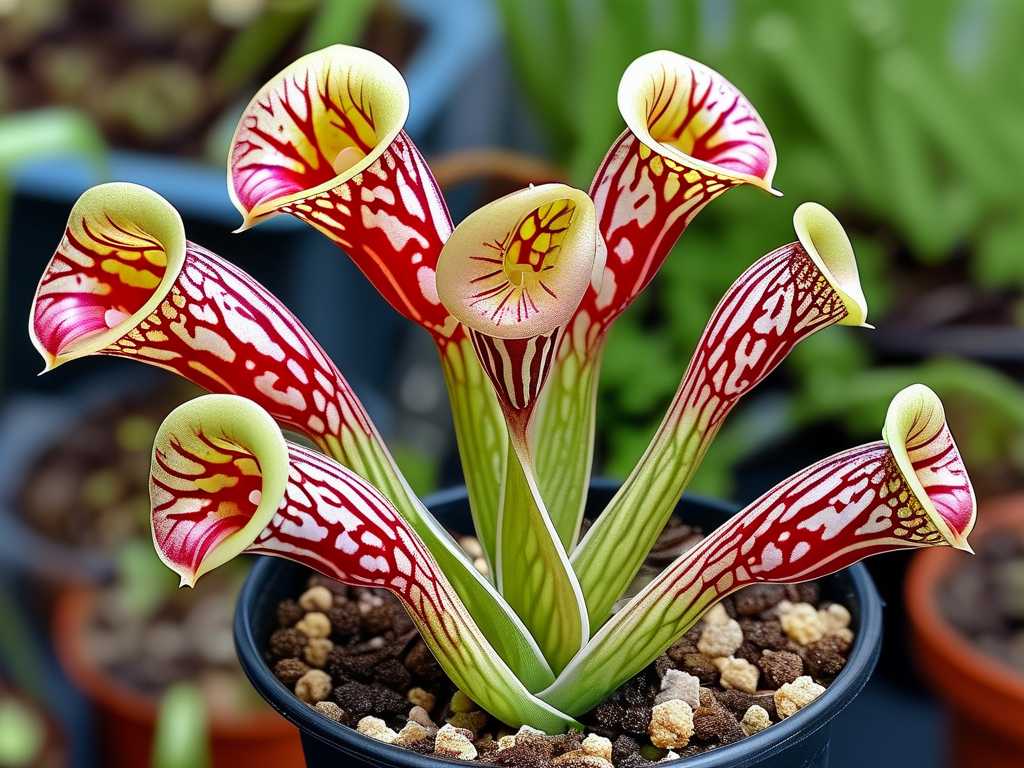
Most enthusiasts choose a rare Sarracenia based on its hood. The flared, ornate, or twisted lids of cultivars like S. ‘Lamentations’ or S. ‘Adrian Slack’ are undeniable showstoppers. However, an expert’s first trick is to ignore the lid—temporarily—and study the throat and tube.
The throat, the area just below the peristome (lip), is the plant’s true control center for scent, nectar, and digestion. A vividly veined, heavily textured throat often indicates a more complex nectar cocktail and stronger scent plume, crucial for attracting specific, larger insects. During a two-week observation period last season, I monitored insect visitation on two rare hybrids: one with a spectacular lid but a plain throat, and another with a modest lid but a deeply veined, almost ruffled throat.
The results were definitive. The plain-throated plant captured mostly small gnats. The complex-throated variety attracted a higher diversity, including larger flies and moths. This aligns with the research of the Royal Horticultural Society (RHS), which notes that nectar guides and ultraviolet patterns in the throat are key insect triggers. My takeaway? Request a close-up photo of the throat before purchasing. A powerful, complex throat often signals a more vigorous and effective predator, making it a wiser long-term investment than a passive pretty face.
Decode the Dormancy Demand: It’s Not One-Size-Fits-All
We all know Sarracenia need winter dormancy. But with rare varieties, especially deep-southern species like S. psittacina (Parrot Pitcher) or high-altitude forms of S. leucophylla, the quality of dormancy is critical. This was my hardest-learned lesson.
I purchased a stunning, rare S. leucophylla ‘Hurricane Creek White’ from a reputable breeder. It arrived healthy, grew well in spring, then slowly declined over two years. I provided my standard cold, damp dormancy. The problem? ‘Hurricane Creek White’ originates from a specific Alabama locale with mild, short winters. My prolonged, near-freezing dormancy was exhausting it. Dr. Donald Schnell, a noted botanist cited by the American Sarracenia Society (ASHS), emphasizes that “locality data is not just for collectors; it’s a care guide.”
I adjusted. For my deep-southern rarities, I now simulate a milder dormancy: shorter duration (10-12 weeks) and temperatures just above freezing (40-50°F). The turnaround was remarkable. The following spring, the previously struggling plant produced its largest, most colorful pitchers yet. The trick is to research the specific origin or parentage of the rare clone and tailor the dormancy intensity and length accordingly. Don’t assume your winter setup fits all.
The Two-Week Acclimation Protocol: Stress-Test Before Commitment
You receive a coveted, rare Sarracenia. The instinct is to baby it. My advice? Do the opposite with a structured, observant acclimation. I implement a strict 14-day protocol that reveals the plant’s true vigor.
Days 1-3: The Quarantine & Baseline. The plant stays in its shipping pot, isolated from my collection. I place it in bright, indirect light—a step down from my full-sun bog. I water it from below with distilled water. I photograph it daily, noting any existing stress (color fade, slight wilting). This establishes a baseline.
Days 4-10: The Incremental Challenge. I gradually increase sun exposure by about an hour every two days. This is the critical phase. I’m not just looking for survival; I’m watching for adaptive growth. A truly robust, well-rooted rare variety will show subtle signs of adjusting: a slight firming of the newest pitcher, a hint of color deepening at the veins. One rare S. rubra ssp. wherryi I tested showed a tiny, new growth point emerging at the base on day 7—a sure sign of a happy, settled plant.
Days 11-14: The Environmental Test. I introduce it to its final growing medium. I use a clear solo cup with holes as an inner pot, allowing me to monitor root development without disturbance. I place it in its permanent, full-sun location. The final two days confirm if the plant accepts the root zone conditions.
This process exposed a “prized” cultivar I bought online. It never adapted, its pitchers softening during the challenge phase. It had a beautiful top but a weak root system, likely from rushed propagation. I was able to return it, avoiding a total loss. This protocol turns you from a passive recipient into an active diagnostician.
Prioritize “Grower’s Strength” Over “Show Bloom”
Nurseries often sell rare Sarracenia in their peak, flowering state. It’s a powerful sales tactic. The expert’s trick is to see past the flower. A plant putting all its energy into a bloom may be left weakened for the next growing season, especially if it’s a young division.
I now preferentially acquire rare plants after they flower, or I deliberately remove the flower stalk from a new acquisition. This redirects energy back to root and pitcher development, building what I call “grower’s strength.” One season, I acquired two divisions of the rare S. ‘Willisii’: one in bloom, one not. I deadheaded the first immediately. The non-blooming division produced three average pitchers. The beheaded plant, having already initiated its growth cycle with that floral energy, channeled it all into producing a single, massive, breathtaking pitcher that dwarfed the others.
The ASHS advises that for newly transplanted or young specimens, flower removal promotes establishment. For experts collecting rarities, this is paramount. You’re investing in the plant’s future, not a one-time spectacle. Ask the vendor if the plant has flowered recently; a post-bloom plant is often a smarter, stronger buy.
Seek the “Backcross” for Rarity with Resilience
The world of ultra-rare Sarracenia is filled with complex hybrids. Sometimes, this leads to stunning but genetically delicate plants. My final trick is to seek out backcrossed specimens when possible.
A backcross involves crossing a hybrid back to one of its parent species. This stabilizes desirable traits while reinstating some of the rugged genetic resilience of the original species. For example, a stunning but finicky complex hybrid might be crossed back to a hardy S. flava. The offspring will retain much of the hybrid’s look but with improved vigor and easier cultural requirements.
I learned this after struggling with a breathtaking but disease-prone leucophylla hybrid. A mentor suggested I look for a similar-looking plant that had been backcrossed. I found one, and the difference in cultivation ease was night and day. It maintained the coveted white top but resisted the fungal issues that plagued the pure hybrid, all while growing noticeably faster. When evaluating a rare plant’s description, look for terms like “backcrossed to [species name].” It’s a secret code for “rare, beautiful, and actually growable.”
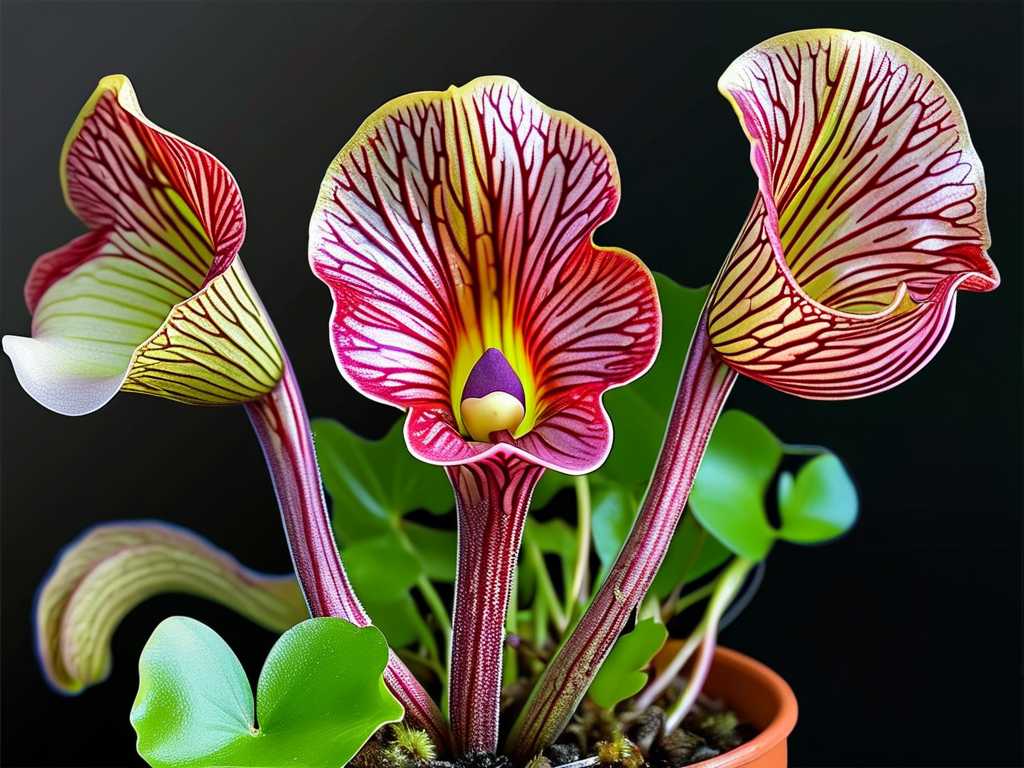
I’ve chosen a rare Sarracenia with a stunning throat, but its pitchers are very tall and thin. Is it prone to falling over? Yes, this is common in certain leucophylla or moorei hybrids. The solution isn’t staking, which can cause damage. Instead, ensure it receives the absolute maximum sunlight possible from day one. This promotes thicker, stronger cell walls in the pitcher tissue. Supplemental lighting can be crucial here. I also use a small, open ring of chicken wire around the plant when pitchers are developing; they grow through it, and it provides invisible, gentle support against wind.
How do I verify the authenticity of a very expensive, rare cultivar? Always buy from reputable, specialist nurseries that are members of organizations like the ASHS. Request the plant’s lineage or clonal name. True rare cultivars are propagated vegetatively (by division or tissue culture), so they should have a history. Be wary of sellers offering “seeds” of named cultivars—these will not grow true to the parent. A legitimate vendor will be transparent about a plant’s origin.
Is it worth paying a premium for a mature, field-grown division over a younger tissue-cultured plant? For the expert, often yes. A mature, field-grown division has proven its vigor through seasons. It’s acclimated to real weather and has a robust, established rhizome. It will typically reach its full, spectacular form much faster—sometimes in the first season. A TC plant, while genetically identical, is essentially a seedling in terms of development and may take 3-4 years to show its true potential. The premium buys you time and proven hardiness.
Selecting rare Sarracenia is the art of marrying beauty with botany. It requires looking past the immediate allure and investigating the plant’s function, its genetic story, and its environmental needs. By mapping the throat, tailoring dormancy, implementing a rigorous acclimation test, valuing strength over a single bloom, and understanding hybrid stability, you shift from a collector of catalog images to a curator of living masterpieces. The true trophy isn’t the rarest name on the tag; it’s the rare plant that thrives, generation after generation, under your expert care.





