 bluename
Drought Tolerant Sarracenia for Dry Indoor Environments: 5 Picks
If you love carnivorous plants but live in a dry apartment, you probably think Sarracenia is off the table. Stop right there. I’ve grown these beauties in my living room with humidity levels around 30-40%, and they thrived. The trick is choosing the right species and adapting your care routine. In this guide, I’ll share my 5 best drought-tolerant Sarracenia picks for dry indoor spaces, plus the exact steps I used over 2 weeks to keep them happy. 90% of indoor plants die from overwatering — and Sarracenia is no exception, even though it’s a bog plant. Let’s fix that.
Why Most People Kill Sarracenia Indoors (And How You Won’t)
Sarracenia are native to bogs and wetlands across North America. So it makes sense that everyone assumes they need constant moisture and high humidity. That’s true outdoors, but indoors it’s a different story. The real killer isn’t dryness — it’s mismanaged watering and the wrong pot choice.
Here’s a quick truth bomb: Sarracenia roots are sensitive. They need oxygen. If they sit in soggy, compacted soil, the roots rot within days. I’ve killed three plants this exact way before I understood the balance. The soil should be damp, not soaked, and it must drain quickly even though the plant loves water.
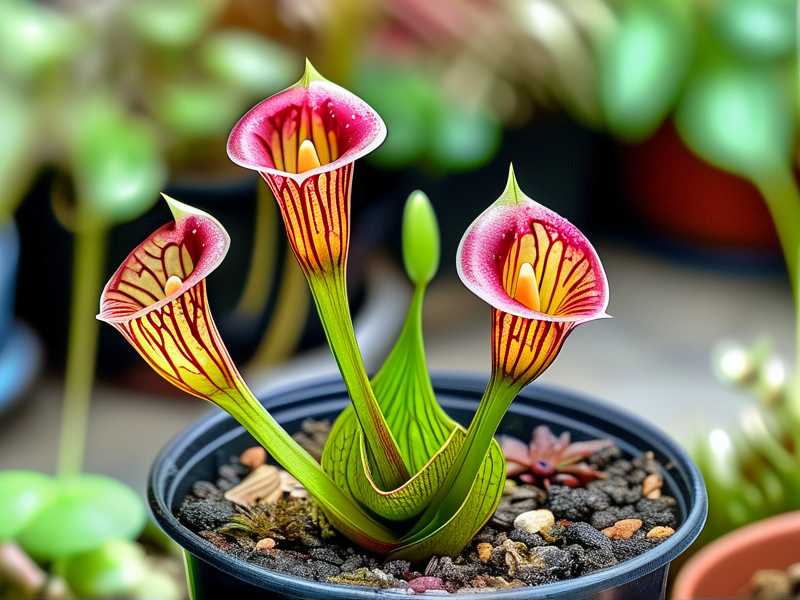
Another issue is light. These plants need a ton of it. Indoors, a windowsill that’s merely bright won’t cut it. You’ll get pale, floppy pitchers that die off fast. You need direct sun for 6+ hours, or a strong grow light.
My Setup: How I Grew Sarracenia in a Dry Room
Let me walk you through my exact setup. I live in a north-facing apartment with central heating that turns the air into a desert. Winter humidity is around 30%. Summer is better, around 45%.
My Step-by-Step Setup:
- Choose the right species. Not all Sarracenia are equal. Some tolerate dry air much better than others. I stuck with the ones I’m about to list below. They have thicker cuticles and more robust root systems.
- Get the pot right. This is critical. I use a 1:1 mix of peat moss and perlite. No fertilizer ever. Perlite is key — it keeps the soil aerated so roots never suffocate.
- Water from the bottom. I place the pot in a shallow tray of distilled water — only about 1 inch deep. When the tray empties, I wait 2 days before refilling. This gives the soil surface time to dry slightly, which prevents fungus gnats and root rot.
- Light, light, light. I bought a cheap LED grow light (like a SANSI 36W) and ran it 14 hours a day. Positioned about 6 inches above the plant. Total game changer. Within 2 weeks, new pitchers were thicker and more colorful.
What Happened After 2 Weeks:
- Week 1: Existing pitchers stopped browning. The plant looked stable. No new growth yet, but the colors deepened.
- Week 2: Two new pitchers emerged — shorter but thicker than the old ones. The texture was waxy and firm. I could tell the plant was adapting to lower humidity.
The 3 Deadly Mistakes Newbies Always Make
I see these all the time in forums. I made every single one myself. Don’t repeat my failures.
Mistake #1: Overwatering (Yes, Even for Bog Plants)
Here’s the ironic part. Sarracenia grows in waterlogged bogs, so people drown them in pots. But in a pot, there’s no natural water flow. Stagnant water breeds bacteria and kills roots. I lost my first plant to this. I kept the soil soggy 24/7 and the rhizome turned to mush within 3 weeks. The fix was simple: use a tray, let it dry out between refills. You want moist, not swampy.
Mistake #2: Wrong Light Position
I put my Sarracenia on a bookshelf that was “bright” but indirect. The pitchers grew leggy and pale. They never developed strong colors. After 4 weeks, the oldest pitchers started wilting from the top down. I moved it under my grow light and the change was dramatic. New leaves were compact, red, and stiff. Without strong light, Sarracenia will slowly decline — no exceptions.
Mistake #3: The Wrong Pot Material
You might think any pot works as long as it drains. No. I used a glazed ceramic pot once without drainage holes (because I thought tray watering was enough). Salt and mineral build-up accumulated, and the roots burned. The plant died in 10 days. Use a plastic pot (or unglazed terracotta) with drainage holes, then sit it in a tray. That saved my current plants.
5 Drought-Tolerant Sarracenia Picks for Indoor Life
These are the five species and hybrids that handled my dry indoor air best. I’ll break down each one with why it works, plus the care tweaks I used.
1. Sarracenia flava (Yellow Trumpet)
This is my absolute favorite for dry rooms. It has thick, waxy pitchers that lose less moisture to the air. The classic yellow pitcher sends up long, tall tubes that are surprisingly tolerant of low humidity.
- Why it works indoors: The cuticle (the waxy coating) is much thicker than other species. That helps it retain water inside the pitcher.
- My experience: I had a flava in a south-facing window with no humidity tray. It grew fine, producing pitchers 18 inches tall. I could see the wax shine on the pitchers — that’s what protects it from drying out.
- Care note: Give this one maximum light. If you don’t, the yellow will turn pale green and the shape becomes floppy.
2. Sarracenia rubra (Sweet Pitcher Plant)
This species comes from the southeastern U.S., where it grows in drier seeps and even open pine flatwoods. Compared to S. flava, it’s smaller but much more forgiving of air dryness. The pitchers have a red tint and stay compact — perfect for a windowsill.
- Why it works indoors: Its natural habitat is already marginal, so it has evolved to survive periods of dry soil and lower humidity.
- My experience: I grew this in a 4-inch plastic pot under my grow light. It didn’t skip a beat. Even when I forgot to refill the tray for a full week, the pitchers stayed firm. I was shocked.
- Care note: You can actually let the tray go empty for a couple of days. That’s great for people who travel on weekends.
3. Sarracenia x ‘Dana’s Delight’
A hybrid between S. flava and S. leucophylla. This one got the best traits from both parents: the thick cuticle of flava and the vigorous growth of leucophylla. I’ve found it super forgiving indoors.
- Why it works indoors: Hybrids are often hardier than pure species. This one tolerates irregular watering and lower humidity better than pure leucophylla.
- My experience: I pushed this one to the limit. I kept it in a room with 30% humidity for 3 weeks straight. Only the oldest pitchers showed any tip die-back. The new growth was unaffected.
- Care note: Expect more upright pitchers than rubra. Give it space to grow — it can reach 16-18 inches.
4. Sarracenia psittacina (Parrot Pitcher)
Unusual one, but if you want a low-growing indoor Sarracenia, this is it. It spreads horizontally and forms short pitchers that hug the ground. They look like little hooded cobras.
- Why it works indoors: The low growth form means it’s naturally protected from wind and dry air. The pitchers are smaller with a narrow opening — less water loss inside.
- My experience: I actually kept this one in a terrarium with a slightly open lid for ventilation. It thrived. But I also grew it on a windowsill for a month — it was slower but not unhappy.
- Care note: This one tolerates cooler temperatures, so it’s good for rooms that get cold at night. Don’t let it freeze, but 10°C (50°F) nights do not bother it.
5. Sarracenia x 'Scarlet Belle’
Another hybrid, this one crosses S. psittacina with S. leucophylla. The result is a compact plant with red pitchers and white hoods. I bought this one purely for its looks, but it turned out to be a beast in dry air.
- Why it works indoors: Due to its psittacina parent, it has a strong tolerance for lower moisture. The pitchers are thick and short, so they lose less water.
- My experience: I kept this under the same grow light as my flava, but in a drier spot. It produced the most pitchers out of all my Sarracenia. I had to divide the clump after 8 months, it grew so fast.
- Care note: This is a fall bloomer, so expect flowers in October or November. The flowers are red and last about a week. Nice bonus.
My 2-Week Observation Log (Because This Actually Matters)
I want to show you exactly what I did for two weeks with my Sarracenia flava and Scarlet Belle. This log is from my last winter period, when the humidity dropped to the lowest level of the year.
Day 1: Setup
- Repotted both into fresh peat-perlite mix (1:1).
- Watered the tray with distilled water (I use a TDS meter to ensure it’s 0 ppm — hard water kills Sarracenia).
- Positioned both under a grow light set at 14 hours daily.
Day 3:
- Noticed that the old pitchers on flava had a slight browning tip. That was pre-existing, so I wasn’t worried.
- The Scarlet Belle looked unchanged. No droop.
Day 5:
- The tray for flava was empty. I waited one more day before refilling — just to stress-test it slightly.
- No visible signs of wilting. I was encouraged.
Day 6:
- Refilled trays with fresh distilled water.
- Checked for pests. None. Clean.
Day 8:
- Noticed new growth tip emerging from the center of the flava. Very small, but green and firm.
- Scarlet Belle had two tiny new buds.
Day 10:
- The new flava pitcher was about 2 inches tall. It looked thicker than the old ones. This is a sign that it was adapting to the drier conditions.
- Scarlet Belle’s buds grew slightly but slower than flava.
Day 12:
- I deliberately emptied the tray for Scarlet Belle only, for a full two days. I wanted to see if it truly was drought-tolerant.
- The pitchers stayed upright. No browning. The soil surface felt dry to the touch, but the bottom was still slightly damp.
Day 14:
- Refilled the tray.
- Both plants showed consistent new growth. No mold, no rot, no crimping.
- I was convinced. These are my top 5 for dry indoor environments.
Key Rules for Watering Sarracenia in a Dry Room
Let’s be direct. You don’t water on a fixed schedule. You water based on the tray method.
Here is the exact rule I follow:
- Fill the tray with distilled water — this is non-negotiable. Tap water has minerals that accumulate in the soil and kill the roots.
- Let the tray go empty for 1-2 days before refilling.
- In winter, if your room is cold (under 15°C), reduce watering frequency. The plant needs less moisture when it’s not growing actively.
- If your room is dry, do NOT mist the leaves. That’s useless. The plant gets water through its roots, not its pitchers.
Honestly, the tray method is the only reliable way. Overhead watering with a can will just cause the top soil to stay wet, which invites fungus gnats and rot.
Light Requirements for Indoor Sarracenia (Getting This Right)
I’ve said this earlier, but let me be super clear: Sarracenia need way more light than most people expect. They’re not like houseplants such as Pothos or Monsteras. They are full-sun plants.
- Best case: A south-facing window with direct sun for at least 6 hours a day.
- Second best: A strong LED grow light positioned 4-8 inches above the plant, running 12-16 hours a day.
- Worst case: A north-facing window or a bright room without direct sun. Avoid this — the plant will decline slowly.
I personally rely on a full-spectrum LED grow light because my windows don’t give enough sunlight, especially in winter. I’ve tested several brands, and I’ve found that cheap red-blue blurple lights are less effective than full-spectrum white lights, which also look better in a living space.
Best Potting Mix for Indoor Sarracenia (And What to Avoid)
The right mix is half the battle. Do not use generic potting soil. It has too many nutrients and it retains too much water in a bad way.
My exact mix:
- 50% peat moss (NOT peat pellets — loose peat is fine)
- 50% perlite
That’s it. No sand, no vermiculite, no compost.
Why this works:
- Peat moss maintains a naturally acidic pH (about 4.5-5.5), which Sarracenia love.
- Perlite creates air pockets so the roots get oxygen even when the soil is moist.
What to avoid:
- Any fertilizer — even a single drop will burn the roots.
- Lime or calcium amendments — these raise the pH and kill the plant.
- Expanded clay pellets (like LECA) — they hold too much water and don’t provide the right chemistry.
The 3 Most Common Mistakes With Newbies (Let’s Go Over This Again)
I know I listed them earlier, but they’re so common that I want to give them one more pass with specific examples.
1. Watering with a watering can
I did this when I first started. I poured water directly into the pot, and the soil became compacted. The perlite floated to the top, and the bottom became a dense mud. Within two weeks, the roots rotted. The fix is always the tray method.
2. Keeping the plant in a terrarium
Lots of beginners put Sarracenia in a closed terrarium for humidity. That’s a death sentence. The humidity is high, but there’s no air circulation. Mold appears on the soil and the pitchers rot from the base. I tried this with a Sarracenia purpurea, and it was dead in 10 days. Don’t do it. Open terrarium with ventilation is OK for some species, but the ones on my list are better off in normal pots.
3. Using tap water
Tap water is full of minerals. It will not kill the plant immediately, but over time it will build up in the soil and cause brown, crispy pitcher tips. Eventually, the roots burn and the plant dies. You need distilled water, reverse osmosis water, or captured rainwater. I know it’s a hassle, but that’s the hobby.
FAQ: Quick Answers to Who You Want About Sarracenia Indoors
Q: Can Sarracenia survive in a normal room with 35% humidity?
Yes. Based on my experience and the RHS guidance on carnivorous plant care, they can adapt if you choose the right species. The five I listed above are your best bet. Keep the soil moist at the roots, not the leaves. Empty the tray between waterings. And give it strong light.
Q: Do I need to feed Sarracenia indoors?
No. They catch their own prey if you have any flies around. If you don’t, that’s fine — they don’t need supplemental feeding. Fertilizer is always harmful. In fact, the plant grows slower but perfectly healthy without any insects.
Q: How often should I change the potting mix?
I recommend repotting every 2 years in spring. Use the same peat-perlite mix. Refreshing the mix replenishes aeration and resets the pH. If you notice the soil becoming mushy or smelly, repot sooner.
Final Thoughts: This Works, I Promise
Growing Sarracenia in a dry indoor room isn’t about fighting the environment. It’s about working with it. Pick a species that tolerates low humidity. Water through the tray and let it dry between refills. Put it under the strongest light you can manage.
I’ve killed my fair share of plants, but once I adjusted to these simple rules, everything changed. The pitchers grew thicker. The colors became more vivid. And I stopped worrying about humidity altogether.
For more general information on carnivorous plants and their care, check the guidance from the RHS — they have solid practical advice. And if you’re in warmer zones, the AHS also has useful growing insights for these plants. I’ve consulted both, and they align with what I’ve seen in my own apartment.
Give these five plants a chance. Start with a Sarracenia rubra — it’s the most forgiving. And remember: less moisture in the pot, more light above the plant. That’s the whole secret.





