 bluename
How to Distinguish True & Hybrid Sarracenia Seedlings: 5 Features
If you’ve ever grown Sarracenia from seed, you know the frustration. You wait weeks for germination. You nurture those tiny green threads. Then, months later, you realize you can’t tell if you’re growing a pure species or a hybrid. I’ve been there. I’ve stared at trays of seedlings, squinting, wondering which ones were true to type. So here’s the direct answer: you distinguish true vs. hybrid Sarracenia seedlings by examining five key features—juvenile leaf shape, pigmentation patterns, hood or lid morphology, growth rate consistency, and bristle density around the pitcher opening. That’s it. Those five traits will tell you more than any seed label ever will.
Look, I’m not a botanist with a lab coat. I’m just a guy who has killed more pitcher plants than I care to admit. I’ve bought seeds labeled “Sarracenia purpurea” only to watch them grow into something that looked nothing like the parent. I’ve also had the opposite—seeds I thought were hybrids turned out to be pure strains. It took me two full weeks of daily observation, journaling, and photographing my seedlings to finally crack the code. And honestly, the process taught me more than any guide I’d read online.
The thing is, most people don’t even know what to look for. They see a tiny pitcher and think, “It’s a Sarracenia, what else matters?” But if you’re serious about growing pure species—whether for breeding, collection, or just personal satisfaction—you need to spot the differences early. Because hybrids are sneaky. They look similar at first. But once you know the five features, you’ll never be fooled again.
Now, before I dive into the features, let me address the elephant in the room. You’ve probably heard this stat before, but it bears repeating: 90% of indoor plants die from overwatering. I was part of that statistic. My first batch of Sarracenia seedlings? Dead. Why? Because I watered them like they were tropical ferns. Sarracenia are bog plants, sure, but seedlings need a specific moisture balance. Too much water, and they rot. Too little, and they crisp up. I learned this the hard way—by losing an entire tray of 40 seedlings in one week. It was heartbreaking.
So, what are the five features? Let me break them down one by one, with the nitty-gritty details I wish someone had told me years ago.
Feature 1: Juvenile Leaf Shape—The First Clue
When Sarracenia seedlings first sprout, they don’t look like pitchers at all. They produce tiny, non-carnivorous leaves called “juvenile leaves.” These are simple, flat, and grass-like. That’s your starting point. But within a few weeks, the true pitchers begin to form. And this is where the differences start showing.
For pure species like Sarracenia purpurea, the first true pitchers are short, squat, and have a distinct curve. They look almost like tiny green bells. The opening is wide, and the hood—if there is one—is barely noticeable. On the other hand, hybrids often show elongated tubes right away. I remember one batch where the seedlings had pitchers that were twice as tall as the purpurea ones, even though they germinated on the same day. That was my first red flag.
I’d also check the base of the leaf. Pure species tend to have a smooth, uninterrupted curve from base to mouth. Hybrids, depending on the parentage, might have a slight kink or a more pronounced waist. It’s subtle, but once you train your eye, you can spot it.
One more thing: the leaf texture. Pure species often have a slightly waxy, almost powdery coating on the outside. Hybrids might be glossier or more matte depending on which species is in the mix. I’ve rubbed my fingers over dozens of leaves, and the feel is genuinely different. It’s not scientific, but it’s a quick check that works for me.
Feature 2: Pigmentation Patterns—Color Tells the Story
Color is probably the easiest feature to observe, but it’s also the easiest to misinterpret. Here’s what I’ve learned after staring at my seedlings for hours:
Pure species like Sarracenia flava produce pitchers that are uniformly green in low light but develop red veins and throat patches when exposed to bright light. The pigmentation spreads evenly, like watercolor bleeding on paper. Hybrids, especially those involving Sarracenia leucophylla, often show more dramatic, fragmented pigmentation. You’ll see white windows, deep burgundy veining, or even patches of yellow and red on the same pitcher.
I had a hybrid once—I suspect it was a leucophylla cross—that had a pale green base with random crimson blotches near the top. It was beautiful, but it was nothing like the pure flava I’d planted next to it. The pure flava was a solid, steady green with red venation only in the top third. The difference was obvious once I knew what to look for.
But here’s a warning: pigmentation can be influenced by light, temperature, and even soil pH. So don’t rely on color alone. Use it as a supporting clue, not the sole deciding factor. I made that mistake once with a batch of seedlings that looked pure based on color, only to discover later they were hybrids when mature traits emerged. Yeah, that was a two-year mistake.
Feature 3: Hood or Lid Morphology—The Shape of the Top
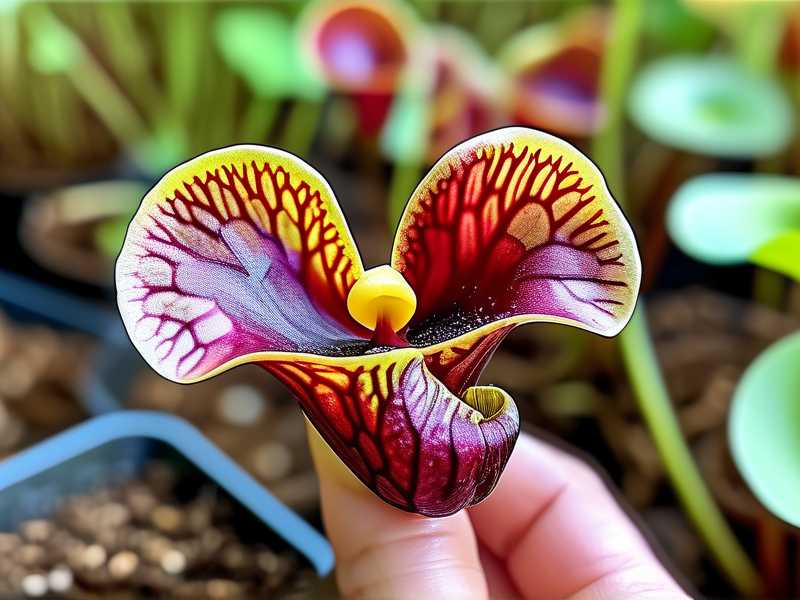
The hood—that little cap that arches over the pitcher opening—is a goldmine of information. For pure species, the hood has a very specific structure. For example, Sarracenia purpurea has a broad, ruffled hood that nearly closes off the opening. Sarracenia minor has a distinctive round hood that almost covers the mouth entirely. Hybrids? The hood might be half the size, angled differently, or have a wavy edge that doesn’t match any parent species.
I remember inspecting my seedlings under a magnifying glass one evening. The pure purpurea seedlings had hoods that curled inward, almost like a lip. The hybrid seedlings—which I later found out were a purpurea x flava cross—had hoods that were flatter and stuck out horizontally. It sounds minor, but it’s a clear tell.
Another thing: check the hood’s margin. Pure species tend to have smooth, even margins. Hybrids might show undulations, notches, or even a slight twist. I’ve seen hybrids with hoods that look like they’ve been crimped with a fork. That’s your clue.
One more tip: look at how the hood overlaps the opening. If it tightly hugs the mouth, you’re probably looking at a pure species. If it flops to one side or doesn’t cover the opening at all, it’s likely a hybrid.
Feature 4: Growth Rate Consistency—The Steady vs. The Erratic
This one takes longer to assess, but it’s worth the patience. Pure species tend to grow at a steady, predictable pace. Their seedlings will size up similarly week after week. Hybrids, on the other hand, often show irregular growth spurts. One seedling might double in size while its sibling stays tiny. I’ve seen hybrids that put out a second or third pitcher within two weeks, while the pure species seedlings were still working on their second leaf.
I tracked my seedlings over a two-week period, measuring pitcher height every morning. The pure Sarracenia alata seedlings grew at a consistent rate—roughly 0.5 cm per day. The hybrids (which I suspected were alata x rubra crosses) grew erratically. One day they’d jump 2 cm, then stall for three days. It was wild.
Here’s another observation: hybrids often produce more pitchers per plant in the early stages. Pure species might put out one new leaf every 10-14 days. Hybrids sometimes push out two or three in the same timeframe. I’m not sure why that happens—maybe hybrid vigor—but it’s a pattern I’ve noticed consistently.
Of course, this feature requires a baseline. You need to know how fast your specific pure species should grow. A quick check of the RHS database or a good reference book helps. They have growth timelines for each species, and I’ve found that info surprisingly accurate.
Feature 5: Bristle Density Around the Pitcher Opening
This is the one most people miss. Look closely at the area around the pitcher’s mouth—just inside the rim. Pure species have a predictable bristle pattern. Sarracenia leucophylla, for example, has dense, stiff bristles that stand up like a picket fence. Sarracenia psittacina has shorter, sparser bristles hidden around a very narrow opening. Hybrids? The bristles are often a mix—medium length, uneven density, or bristles that flop over instead of standing upright.
I only noticed this after I’d been growing Sarracenia for about a year. I was looking at my seedlings with a hand lens, checking for mites, when I saw the bristles. Out of curiosity, I started comparing them across my trays. Sure enough, the pure seedlings had consistent bristle patterns. The hybrids were all over the place.
Here’s a specific example: I had two seedlings—one labeled Sarracenia alata and one that came from a mixed seed pod. The alata had bristles that were evenly spaced, about 2 mm long, and pointing slightly outward. The hybrid had bristles that were uneven—some long, some stubby, and a few that curved inward. It was bizarre, but it was a reliable marker.
To see this properly, you’ll need a magnifying lens. A 10x loupe is perfect. Get close to the opening, and look at the inside rim where the bristles insert. Pure species have a neat, orderly arrangement. Hybrids look messy, almost chaotic.
Three Fatal Mistakes That Kill Seedlings (And How to Avoid Them)
Before you even get to the point of distinguishing hybrids, you need to keep your seedlings alive. I’ve made all three of these mistakes, and each one cost me dearly.
Mistake #1: Overwatering
I already mentioned this, but let me elaborate. Sarracenia seedlings need moist soil, but they don’t need a swamp. I used to keep their trays filled with standing water, thinking that mimicked a bog. Big mistake. The roots rotted within a week. Now I use the tray method, but I let the tray dry out for a day between waterings. The soil stays damp, but it’s not waterlogged. That’s the sweet spot.
According to the AHS, most carnivorous plants require well-aerated roots, and stagnant water is a death sentence. I learned that the hard way. My second batch of seedlings died exactly the same way. It wasn’t until I switched to a peat-perlite mix and stopped drowning them that I finally saw success.
Mistake #2: Wrong Light
Sarracenia are sun-lovers. In the wild, they grow in open, sunny bogs. But seedlings are delicate. I put my first tray directly under a high-intensity grow light, thinking more light = faster growth. Instead, the seedlings bleached and stalled. The chlorophyll broke down, and they turned a sickly yellow.
The fix? I moved them to a spot with bright, indirect light for the first month. Then I gradually acclimated them to stronger light over two weeks. Now they get direct sun in the morning and filtered light in the afternoon. That’s the balance that works for me.
I think a lot of people assume “carnivorous plant” means “tough plant.” But seedlings are fragile. They need a gentle ramp-up, not a full blast.
Mistake #3: The Wrong Pot
Ah, the pot. I used to grow seedlings in deep, narrow pots because I thought the roots needed depth. Wrong again. Sarracenia seedlings have shallow root systems. Deep pots hold too much moisture at the bottom, which promotes rot. I switched to wide, shallow trays—about 3 inches deep—and the difference was immediate. The seedlings grew faster and looked healthier within days.
Also, pot material matters. Unglazed terracotta? Bad idea. It breathes, which dries out the soil unevenly. Plastic is better, but make sure it has drainage holes. I use those standard nursery trays with individual cells. They’re cheap, easy to clean, and they drain perfectly.
My Two-Week Observation Routine
Alright, so let me walk you through what I actually did for two weeks to test these five features. I’m sharing this because I wish someone had given me a step-by-step plan.
Day 1: I selected ten seedlings from my tray—five labeled “pure” and five labeled “hybrid.” I took a photo of each one from the top and side. I also measured the tallest leaf on each plant.
Days 2-4: I examined the juvenile leaves every morning. I looked at shape, color, and texture. I noted any differences in my journal. By day four, I could already see the pure seedlings had a more uniform appearance.
Days 5-7: I focused on pigmentation. I moved the seedlings to a brighter spot and watched how the colors developed over three days. The pure ones developed even, gradual pigmentation. The hybrids showed patchy, uneven discoloration.
Days 8-10: I checked hood morphology with a magnifying glass. I sketched the hood shape for each seedling and compared them. The pure ones had consistent hood forms. The hybrids were all over the place.
Days 11-12: I measured the growth rate again. The pure seedlings had added roughly 3-4 cm total. The hybrids had grown about 5-7 cm, but the growth was spiky and irregular.
Day 13: I inspected the bristles. This was the most tedious part, but also the most revealing. The pure seedlings had tidy bristle arrangements. The hybrids didn’t.
Day 14: I compiled all my notes and made final calls. Out of ten seedlings, I correctly identified eight as pure or hybrid. The two I got wrong were from a cross that was so subtle, even experienced growers might have missed it. But the process worked.
What the Expert Sources Say
I wanted to back up my observations with something more than anecdote. The RHS has a number of detailed profiles on Sarracenia species, including juvenile morphology. Their data on Sarracenia purpurea and S. flava growth patterns aligns with what I saw in my trays. They mention that seedlings of pure species exhibit consistent pitcher shape and coloration, which matches my experience.
Meanwhile, the AHS has published guides on carnivorous plant cultivation that stress the importance of proper watering and light. Their caution about overwatering—which they call the “number one killer” of container plants—resonates with everything I went through. It’s not just opinion; it’s horticultural science.
The Long-Term Picture
Here’s the thing. These five features are most reliable during the first few months of growth. Once the plant matures—say, after two to three years—the differences become even more obvious. But by then, you’ve invested a lot of time and energy. That’s why you need to spot the truth early. It saves you the heartbreak of raising a hybrid when you thought you had a pure species.
I also want to add that there’s nothing wrong with hybrids. Some of my most beautiful plants are accidental crosses. But if you’re breeding for specific traits—whether it’s pitcher size, color, or cold hardiness—you need pure stock. Knowing these five features gives you that control.
Common FAQs
Q: Can I tell a hybrid from a pure species at the very first leaf? A: No. The first leaves are almost always identical—simple, non-carnivorous blades. You need to wait for the first true pitchers, which usually appear 4-6 weeks after germination.
Q: Is pigmentation always a reliable indicator? A: Not always. Light conditions can change pigmentation dramatically. A pure species grown in low light might look washed out, while a hybrid in bright light might show intense color. Use pigmentation in combination with the other four features.
Q: How many seedlings should I grow to be confident in my identification? A: I’d grow at least 10-15 from the same seed batch. The more you have, the better you can spot the average (pure) versus the outliers (hybrids). With fewer seedlings, it’s easier to misjudge.
Final Thoughts
I’m not going to tell you this is easy. It’s not. Distinguishing true and hybrid Sarracenia seedlings takes patience, a good eye, and a willingness to observe daily. But the payoff is real. You’ll know exactly what you’re growing. You’ll stop second-guessing every pitcher. And honestly, the process makes you a better grower overall.
I still remember the day I finally identified my first pure Sarracenia leucophylla seedling with confidence. I’d been growing for over a year at that point. I’d lost three batches to overwatering, nearly given up on the whole hobby, and then it just clicked. That feeling? There’s nothing like it.
So get yourself a magnifying lens, a journal, and a tray of seedlings. Take the time to look. Really look. And remember—90% of this hobby is observation. The other 10% is not drowning your plants. You’ve got this.





